
Every seller who watches what actually sells on social platforms eventually reaches the same shelf: the accessories that creators buy before they film anything. A tripod that wraps around a bike handlebar. A wireless microphone that clips to a t-shirt. A palm-sized light that makes a kitchen counter look like a studio. These are small, light, shippable products with high repeat potential — which is exactly why the category is crowded and why the difference between a good buy and a returns machine is invisible in a marketplace listing.
This guide is written for the buyer who has decided to build a smartphone video accessory line — a few SKUs or a bundled kit — and needs to know how to source it from China without guessing. It covers the product categories, the specifications that decide whether customers keep or return an item, how to compare suppliers, and what to test before you pay for production. For the wider picture of how a product idea becomes a sourcing request, our pillar guide on discovering new products in China covers the funnel end to end.
The Main Product Categories
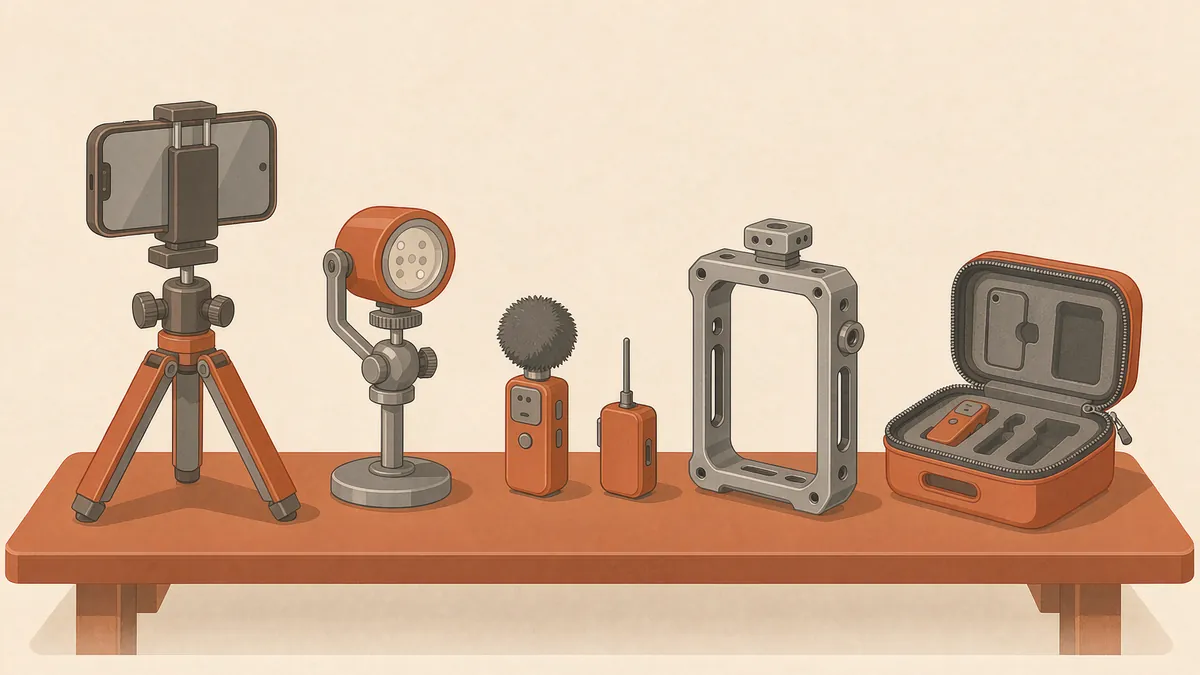
Tripods and phone mounts. The workhorses of the category: desktop tripods, flexible "gorillapod-style" legs, selfie-stick tripods, and clamps that mount a phone to anything with a thread. Almost every serious accessory uses the standard 1/4-inch-20 thread somewhere — the same screw the camera industry has used for decades — which is the first compatibility question to ask any supplier: what threads do your mounts and ball heads accept?
Lighting equipment. Slim LED panels, small ring lights, and clip-on fill lights that draw power from a battery or a power bank. The specification sheet matters more here than in any other subcategory: brightness, color temperature range, and color accuracy decide whether the light is usable or a toy.
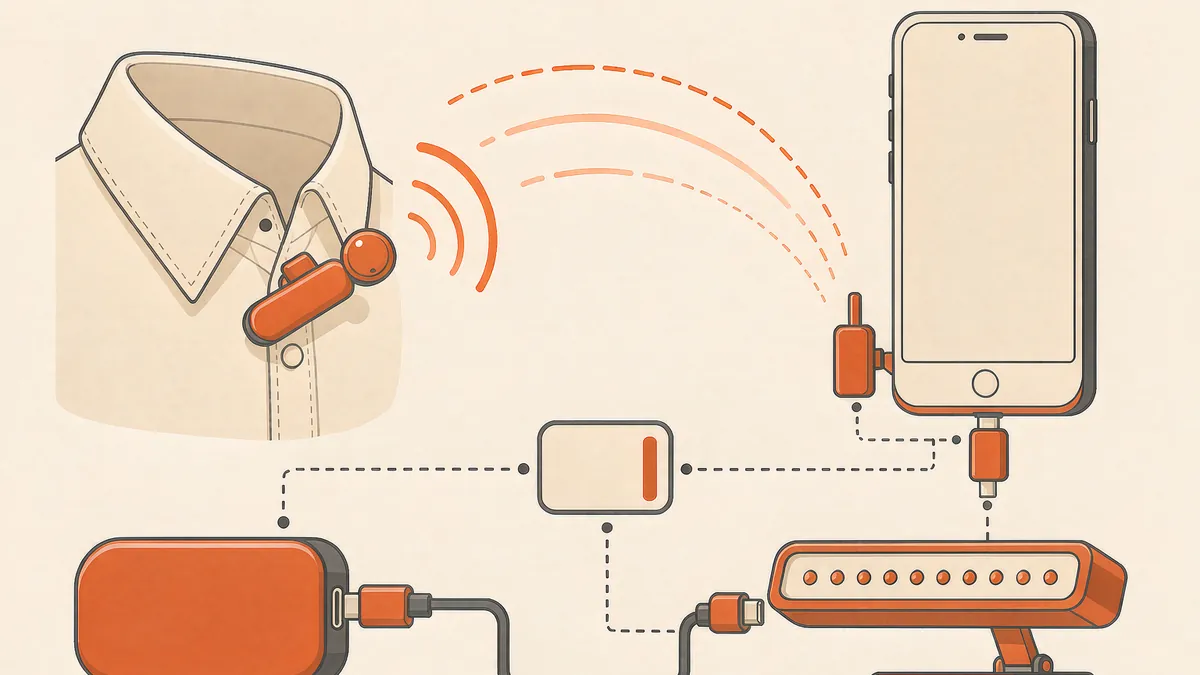
Wireless microphones. Clip-on lavalier transmitters with a small receiver that plugs into the phone — usually through USB-C or a 3.5mm jack. This is the highest-technical-risk subcategory in the group, because audio involves radio regulations that differ by destination market (more on this below).
Phone filming rigs. Metal cages and handles that turn a phone into a handheld rig with attachment points for lights and microphones. Heavier, lower-volume, but higher perceived value — a common mid-line product for accessory brands.
Portable creator kits. A bag or case bundling a tripod, light and microphone into one SKU. Bundles raise average order value, but they multiply the quality risk: the kit is only as good as its weakest component, and every component is a separate thing that can fail.
The Specifications That Decide Returns
Compatibility. Ask for the clamp's actual opening range in millimetres — most phone clamps open to somewhere in the 60–90 mm range, which excludes larger phones in cases. If your market is iPhone-heavy, ask whether the supplier offers magnetic mounts; be aware that "MagSafe" is Apple's trademark, so listings and product moulds should describe compatibility carefully. For audio, confirm the receiver connection type — USB-C, Lightning, or 3.5mm — because a microphone that cannot plug into your customers' phones is a guaranteed return.
Materials and build. Tripod legs: ABS plastic is fine for desk use but flexes under a phone plus a light; look for aluminium legs and metal ball heads once the load grows. Phone cages: aluminium or steel, with the finish specified (anodised vs painted — painted finishes chip). Clamps: ask about spring steel fatigue, the part that silently fails after a few hundred open-close cycles.
Battery and power. For lights and wireless mics, ask for battery capacity in mAh, charge time, and whether charging is USB-C. Ask what happens at 20% battery: does the LED dim, does the transmitter drop out? Run-time figures from suppliers are measured in their own conditions — treat them as claims to verify, not facts to reprint.
Connectivity. Dedicated 2.4 GHz wireless systems generally pair faster and hold a more stable link than Bluetooth for this use, which is why most serious clip-on microphones have moved that way — but the receiver must match the phone, and the radio must be legal in the destination market. Radio regulations for wireless microphones differ by country and frequency band; whether a specific model can be sold in the US, UK, EU or Australia must be checked against that model's certifications, not assumed from a similar product.
Stability. The test that predicts returns: mount a phone, add the heaviest accessory a customer would realistically combine, and check for sag, drift and joint slippage. A ball head that cannot hold a phone plus a light at an angle will generate complaints no matter how good the price was.
Packaging. Creator accessories are gift-adjacent purchases. Ask for retail-ready packaging options, inner tray protection for the battery items, and packed carton dimensions early — small items in bulky retail boxes can ship surprisingly badly.
How to Compare Suppliers
The category has an unusually wide supplier mix: electronics factories that make microphones and lights, metal shops that make tripods and cages, and trading companies that bundle components from several of them. That mix is normal, but you want to know which one you are talking to, because it changes who can fix a defect.
Compare suppliers on the same sheet, the same way you would compare any sourcing candidate:
- What is manufactured in-house versus bought in?
- Which brands or markets have they produced for (ask for the product categories, not confidential names)?
- What is the defect rate they will stand behind, and what is the remedy — repair, replacement, credit?
- Can they provide conformity documentation for the radio and battery items in your destination market?
- What is their sample policy and sample lead time?
A supplier who answers those five questions specifically is worth a sample order. One who answers in brochures is not. Our guide on contacting Chinese factories covers how to open that first exchange so it gets a real reply.
What to Check Before Ordering Samples
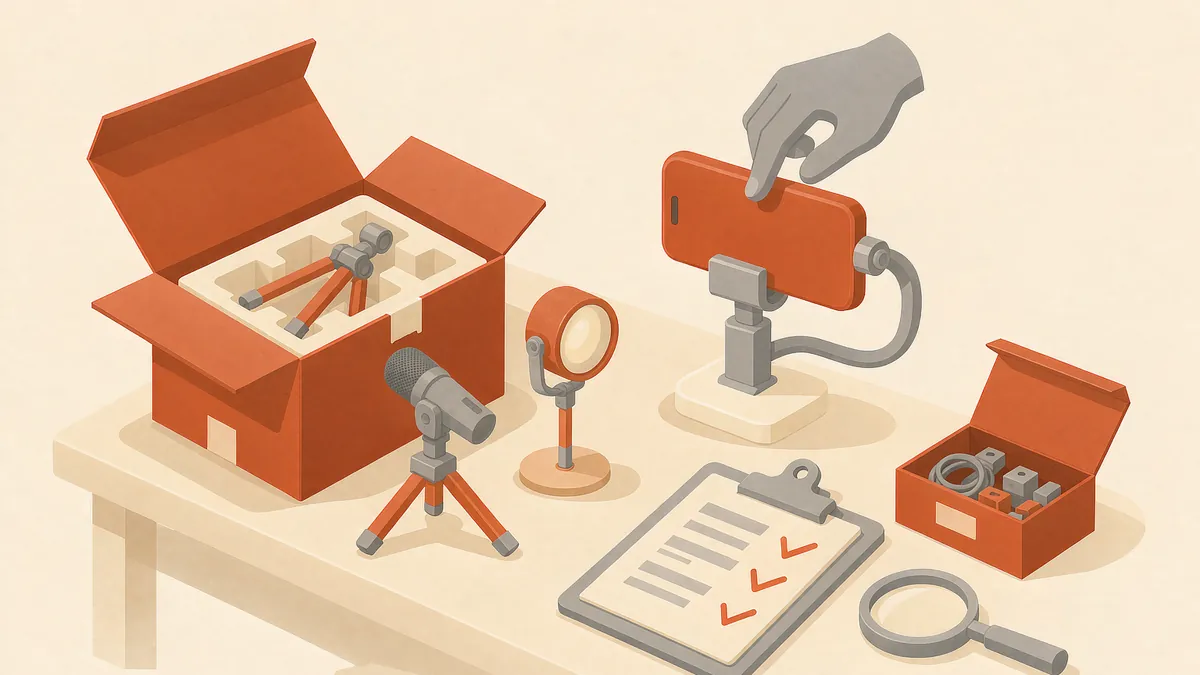
Sample the exact SKU configuration you intend to sell — not "whatever they have". Before the samples ship, write down what you will test, because a sample that arrives and "looks fine" teaches you nothing:
- Fit test: does the clamp hold your reference phones — with cases on — without wobble?
- Thread test: do the mounts actually mate with standard 1/4-inch-20 accessories you own?
- Light test: cycle brightness and color temperature; check the low-battery behaviour; time a full charge against the supplier's claim.
- Audio test: record with the microphone in a real room and in a car; listen for dropouts, hiss, and pairing delays; confirm the receiver connection matches your market's dominant phone.
- Cycle test: open and close the clamp and fold the tripod fifty times; feel for loosening.
- Document check: for radio and battery items, ask for the certificates and test reports that apply to your destination market — and treat documents the same way you treat run-time figures, as claims to verify.
We keep a fuller procedure in our guide on evaluating product samples before a bulk order.
MOQ, Pricing and Product Configuration
MOQs in this category vary enormously by product type, and no honest number can be quoted in general — a generic phone clamp and a certified wireless microphone system sit at opposite ends of the tooling and certification cost curve. What you can do is ask the right questions per SKU: the MOQ per color or variant, the MOQ for custom packaging versus neutral packaging, the price break at two or three quantity tiers, and what configuration changes (different cable, different clamp width, bundled kit) do to both MOQ and unit price.
Two configuration decisions shape the whole economics of the line. First, colors: every additional color is inventory you must sell through, and for most accessory brands two or three colorways cover nearly all demand. Second, kits: a bundled kit raises your average order value but multiplies component suppliers, packaging complexity, and the number of things that can be missing from the box. If you start with a kit, get the pack-out list in writing — which components, in which bags, from which sub-supplier — before production.
How AllexTrade Sources This Category
AllexTrade is a China product discovery and sourcing service. For a smartphone video accessory line, that means:
- Product discovery: you bring the market positioning — budget line, mid-line or bundled kit — and we surface candidate products and configurations that fit it.
- Supplier sourcing: we identify factories and screened trading partners for each component category, and approach them with your specification.
- Specification and matching: we translate compatibility requirements — threads, clamp ranges, receiver types, radio certifications — into a sheet suppliers can quote against.
- Quotations and MOQ: we collect comparable quotes and confirm MOQ and pricing per configuration.
- Samples and quality checks: we arrange samples, coordinate the evaluation against your test list, and coordinate quality inspection before shipment.
- Production and delivery: we coordinate the production order, export logistics and delivery.
Request Product Discovery: send your product reference, target market and estimated quantity through our sourcing request form, or read how the service works. If you are also building an adjacent mobile accessory line, our guide on sourcing car phone holders covers the mount and clamp quality checks in detail.
Frequently Asked Questions
What should a starter creator kit include? The core three: a tripod or mount that fits standard threads, a small LED light, and a wireless clip-on microphone. Everything else — cages, handles, extra lenses — is a line extension. The kit is only as strong as its weakest component, so each component needs its own sample test.
What MOQ do Chinese suppliers require for phone video accessories? It varies widely by product type — from tens of units for simple generic clamps to hundreds or more for configured electronics like wireless microphone systems — and it changes again for custom colors, packaging or kits. Treat every MOQ as a per-SKU, per-configuration question to confirm in writing, never as a category average.
Are wireless microphones legal to sell in my market? Wireless microphone regulations differ by country and frequency band, and certification requirements are model-specific. Before committing to a model, confirm which certificates apply to your destination market — US, UK, EU and Australian requirements are not interchangeable — and verify the documents against the specific model, not a similar product.
How do I make sure the accessories fit my customers' phones? Ask for the clamp's opening range in millimetres, the receiver's connection type (USB-C, Lightning or 3.5mm), and the thread standard on every mount. Check those three numbers against the phones that dominate your market — with cases on, which adds several millimetres.
Can suppliers customize branding and packaging? Usually yes, but customization raises MOQ and lead time, and the packaging MOQ is often higher than the product MOQ. Confirm both numbers per SKU, get the pack-out list in writing, and sample the packaging itself — retail boxes with thin trays ship badly and arrive crushed.
Small batch? That's our specialty.
AllexTrade negotiates low-MOQ production across screened factories. Tell us your product and target quantity and we'll come back with realistic options and prices — timing depends on how quickly suppliers respond.