
A car phone holder with a 360-degree rotating joint just showed up at the top of a third-party TikTok Shop US trend list, with an estimated $182.6K in seven days and the fastest growth rate on the entire list. If you sell automotive accessories, the immediate question is whether to chase it. The better question is different: if demand does hold up, do you know how to buy this product well?
Because the hardware itself is unforgiving. A phone mount is one of the few car accessories that fails in front of the driver on every single trip. When the joint loosens, the phone droops. When the clamp relaxes on a bumpy road, the phone drops. When a suction cup gives up on a hot afternoon, the product ends up on the floor and the customer ends up writing a one-star review. The category rewards factories that understand small mechanical details and punishes importers who bought on price alone.
This article covers both sides: what the trend data does and does not tell you, how the product is actually built, what separates a mount that lasts from one that does not, and a sample test checklist you can run before committing to an order.

What the trend data actually says
First, the numbers, and then the caveats, because both matter.
Third-party platform TokConnect publishes a rising-products list for TikTok Shop US. Its report covering the 7 days from 20 October 2026 to 26 October 2026 lists "Car phone holder 360 degree rotation" as the fastest-growing product on the list:
| Metric | Reported value |
|---|---|
| Product | Car phone holder 360 degree rotation |
| Category | Automotive & Motorcycle |
| Listed on TikTok Shop | 11 August 2026 |
| Est. 7-day revenue (20–26 Oct) | USD 182.6K |
| Growth vs prior 7 days (13–19 Oct) | +763% |
| Est. 7-day units | ~3,000 |
| Listed retail price | USD 59.99 |
| Reported creators selling it | 5 |
Read that table with five qualifications attached:
- The window is one week. The figures cover 20–26 October 2026 against the prior week of 13–19 October. That is a snapshot, not a season.
- These are third-party estimates. TokConnect derives them from publicly visible TikTok Shop signals. They are not TikTok's official sales reporting and they are not our numbers.
- USD 59.99 is a retail reference price. It is what the listing charges consumers. It says nothing about factory pricing, and any margin math built on it would be fiction — so we are not doing any.
- This is not an AllexTrade ranking. We checked our own US ranking snapshots pulled 28 October 2026, and this product does not appear in them. You can browse what our snapshots do cover on the trending products page — and we will not pretend a product is there when it is not.
- A +763% week does not guarantee anything. The list itself notes that a product lifted by a handful of creators can fall as fast as it rose. Five reported creators driving $182.6K is a very thin base: the growth is concentrated, unverified, and could reverse within days.
So treat the data as a prompt to understand the product, not as an order trigger. That is true for any spike, and it is the honest reading of this one.
The three mount architectures
"Car phone holder" is not one product. Factories group themselves by which base they are good at, and each base changes the failure modes:
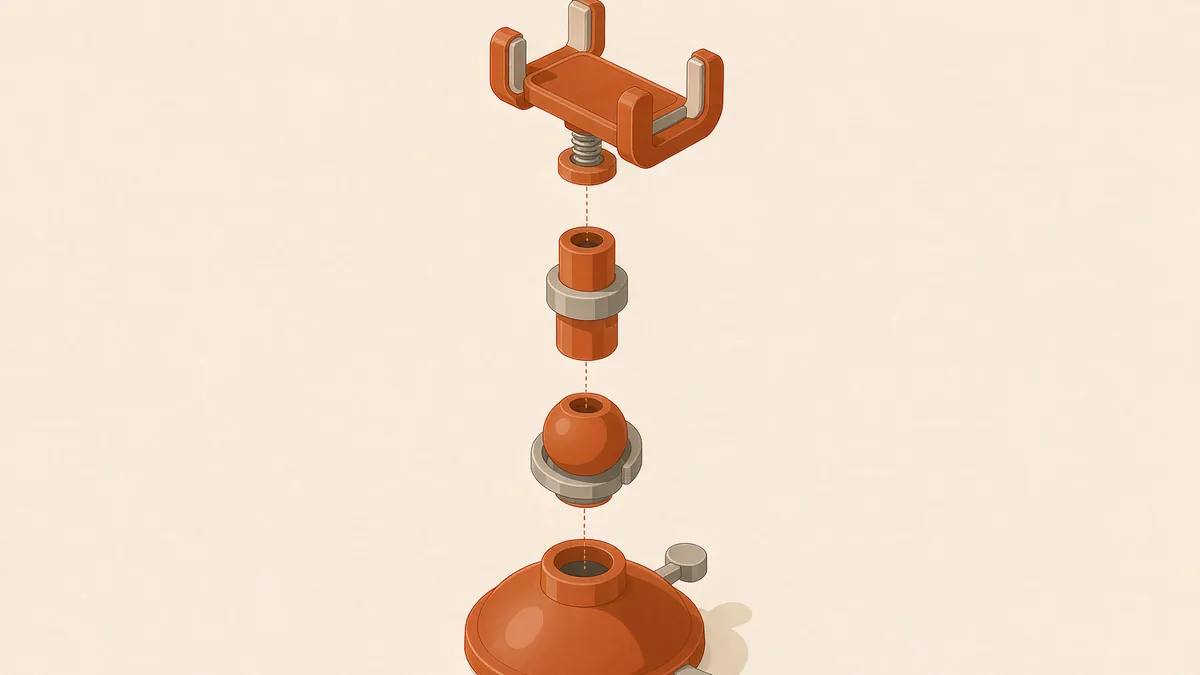
- Suction-cup mounts attach to the windshield or a smooth dashboard. They offer the most placement freedom and the strongest hold — when fresh. The suction pad, the locking lever, and the pad-to-dashboard surface condition decide everything. This is the architecture in the trending listing.
- Vent-clip mounts hook onto the air-conditioning louvers. No adhesive, no residue, easy to move between cars. But they inherit the vehicle's problems: thin or curved vent fins, heavy phones bending the clip, and hot or cold air blowing directly at the phone.
- Dashboard-base mounts use a weighted or adhesive-backed base sitting on the dash. Stable and discreet, but they need a flat, textured-tolerant base pad, and adhesive quality becomes a heat question.
For a 360-degree product, the rotating joint is shared across all three bases — which is why the joint, not the base, is where your QC attention should concentrate. When you shortlist a car phone holder supplier in China, ask which architectures they run in-house and which they buy the base for. A factory that molds the cradle and joint itself but buys suction cups from a sub-supplier is normal; one that cannot tell you where the ball joint is made is not.
The rotation joint is the product
The "360 degree" in the product name is the joint that lets the phone swivel from portrait to landscape and tilt toward the driver. It is also the part buyers complain about most. Three questions decide whether the joint survives:
- Does it hold torque? The joint should stay where you set it — the phone should not slowly sag under its own weight on a bumpy road. Ask the supplier what mechanism provides friction: a threaded collar, a ratchet washer set, or a plain press-fit. A plain press-fit is the cheapest and the first to loosen.
- How does it age? Every rotation cycle polishes the contact surfaces. Joints that feel firm in the showroom loosen after weeks of daily repositioning. Ask what the friction surfaces are made of — a POM or nylon washer against a metal ball wears very differently from plastic on plastic.
- What is the cycle spec? Serious manufacturers can state a rotation-cycle expectation. Ask what test they run and at what torque the joint is considered worn out. A supplier who answers with a number has a test; a supplier who answers "very good quality" has neither.
The metal content of the joint is a good proxy for the factory's positioning. A zinc-alloy or steel ball with a metal collar costs more than an all-plastic one, and mounts built around them sell to different buyers. Know which one you are quoting before you compare prices — comparing an alloy-joint quote against a plastic-joint quote tells you nothing.
The clamp: grip, one hand, and cases
The cradle is where the phone actually lives, and three details decide whether customers keep the product:
- Clamp force vs. one-hand operation. The arms need enough spring force to hold a large phone, but a driver should release it with one hand. This is a spring-and-linkage geometry problem, not a materials problem. Ask how the supplier balances the two; the good ones can explain their arm travel and spring spec without checking.
- Case compatibility. Most US buyers do not use bare phones. The clamp must open wide enough for a phone in a rugged case — roughly 17 mm of grip width is a common design target — and the padded arms must not press side buttons on popular phone models. Ask for the cradle's max opening width and have the supplier confirm which case thicknesses it accepts.
- Padding. The contact pads should be silicone or TPE, not hard plastic. Hard pads slip on glossy cases and scuff them — a small detail that generates a disproportionate share of negative reviews.
Stability on real roads
The failure scenario that matters is not a showroom demo; it is six months of potholes, hard braking, and summer heat. A mount can pass a hand-shake test at the factory and still fail on the highway. When you evaluate stability, ask about three mechanisms:
- Joint stiffness under load. With the largest supported phone installed, does the joint hold position when the mount is tapped from below and from behind? Ask how the factory measures this, if they do.
- Base anchorage. For suction mounts: how does the locking lever prevent slow vacuum loss? For vent clips: what range of fin thickness and curvature does the hook accept? A clip designed around straight, stiff fins will rattle loose on the curved, thin fins common in newer cars.
- Vibration behavior. Cheap joints develop a buzz on rough roads long before they visibly fail — the phone trembles at idle and the customer loses trust before anything breaks. Suppliers who ride-test or bench-test for micro-vibration are rare; ask the question anyway and note who can answer it.
You are not expecting every factory to have a full test lab. You are checking whether the supplier understands the failure physics or is just molding plastic to a drawing.
Materials and heat
A car interior is a harsh environment disguised as a mild one. A dashboard in a parked car in an American summer can reach temperatures that soften low-grade plastics, and the mount sits on it in direct sun. The materials conversation with a car phone holder manufacturer in China should cover:
- Body plastics. ABS is common and cheap; PC (polycarbonate) blends hold stiffness at higher temperatures; reinforced nylon shows up in load-bearing arms. Ask which resin each part uses and whether it is virgin material — recycled feedstock is common in this category and shows up as brittleness.
- Heat deflection. Ask whether the material spec includes heat resistance relevant to dashboard environments, and at what temperature the cradle arms may relax. You are asking about the spec sheet, not demanding certification — the point is to learn which suppliers know their own materials.
- Contact surfaces. Silicone pads on the clamp, a rubber or gel suction pad, and TPE rings inside the joint all age with heat and UV. Cheap pads flatten and go shiny; the suction cup is usually the first part to die in a hot car.
- Metal parts. The ball joint and the spring are the two places metal earns its cost. Confirm the spring is steel, and ask whether the ball is metal or plastic.
Fit and installation coverage
Compatibility is broader than phone size, and the differences between markets show up here:
- Phone range. The cradle should cover roughly 4.7-inch to 6.9-inch phones, plus the case allowance above. Confirm both the minimum and maximum grip widths, not just "fits all phones."
- Orientation. The 360-degree joint is what makes portrait-to-landscape switching possible — verify the joint locks positively in landscape, where lever-arm torque on the clamp is highest.
- Vehicle positions. Windshield-mount laws vary: some US states restrict windshield placement. A product sold as "universal" should still document its intended mounting positions. For vent mounts, ask which vent-fin geometries were considered in the design.
- Cable routing. Small but real: mounts that block the charging port generate returns. Check the cradle's bottom edge clearance.
This is the same discipline we apply across automotive accessories sourcing from China: the product looks simple, but the fitment matrix is where the engineering lives.
Getting quotes you can actually compare
Once you have shortlisted two or three factories, the work is making the quotes comparable. Car phone mounts have several cost dials that factories set differently unless you pin them down:
- MOQ. Stock-color, unbranded mounts often start low — several hundred pieces; custom colors, packaging, or logo printing raise it. Set your MOQ conversation against your actual first-order plan, and see how to choose the right MOQ for the trade-offs.
- Samples. Always sample before quoting conclusions. Ask for a sample built from the actual production mold, not a hand-finished showroom piece — the difference is exactly where mass-production problems hide. Our walkthrough of evaluating a product sample before a bulk order covers the protocol.
- Packaging. This product ships in polybags, blister packs, or color boxes. Blister adds tooling; color boxes add print minimums. Rotating joints and springs should ship with the joint in a fixed position to avoid settling.
- Customization. Logo printing on the cradle, custom pad colors, or a retail-ready box are all quoteable line items — but each one changes the tooling and the lead time. Get them priced separately, not baked into one number.
- Lead time. Two very different timelines hide behind "30 days": one for stock-mold production and one that includes new mold or packaging development. Ask which timeline your quote assumes.
- Comparability. Send every factory the same brief — same mount architecture, same materials expectations, same quantity — so the quotes come back comparable. If you are weighing sample cost against bulk pricing, sample vs. bulk quote explains why the cheapest first quote is rarely the cheapest order.
Risks that are specific to this product
Beyond general import risk, four issues concentrate in this category:
- Design and utility patents. Mount mechanisms — locking levers, one-hand release geometry, magnetic attachment systems — are heavily patented, and some of the best-known designs are aggressively defended. Do not ask a factory to "copy" a branded product; ask what original designs they own. The branded listings you can see are not a sourcing brief.
- Trademarks. Never ship a product bearing a brand name, a phone brand's logo, or "MagSafe" unless you own the license — the connector ecosystem has its own licensing regime. Unbranded, clean-surface products avoid this entire class of risk.
- Complaint clusters. In this category the reviews cluster around predictable failures: the suction cup dying in heat, the joint sagging under a heavy phone, vent clips snapping in cold weather, and pads marking glossy cases. Your sample checklist below targets exactly these.
- Returns and after-sales. A mount that fails is cheap to replace and annoying to return. Ask whether the factory packs spare pads or replacement suction cups, and what their policy is on parts — small spares can save a review score.
A sample test checklist you can run yourself
You do not need a lab to evaluate car phone mount samples. You need a week, a car, and discipline. The checklist below is a starting point — adapt it to your product and market, and record what you observe rather than what you hope:
- Install the mount in three different cars (different dash textures and vent types if evaluating multiple bases).
- Mount and unmount the phone 30 times. Note whether the one-hand release stays smooth and whether the pads scuff a cased phone.
- Rotate the joint portrait-to-landscape 50 times. Check whether friction feels the same at the end as at the start.
- Set the phone in landscape and tap the dashboard firmly from below ten times. The phone should not sag.
- Drive one week of normal use, including at least one rough-road trip. Look for vibration buzz at idle and droop after bumpy sections.
- Simulate a hard brake from low speed in an empty parking lot — with a cased, heavier phone, not a bare one.
- Leave the mount on the dashboard in direct sun for a full day. Check pad tackiness, arm stiffness, and any warpage the next morning.
- Test the widest cased phone you intend to sell to, including button access.
- Uninstall and reinstall the suction base five times on two different surfaces; inspect the pad for deformation.
No factory sample will pass every line perfectly. What you are looking for is which failures appear, whether the supplier can explain them, and whether they commit to a fix in production — that conversation is a better supplier qualifier than any certificate.

Frequently asked questions
Is the +763% growth a reliable signal to enter this product now? It is a signal to investigate, not a guarantee. The figure comes from one third-party estimator, covers a single week (20–26 October 2026), and rests on about five creators. Fast risers with thin creator bases can reverse quickly — validate demand on your own channels before committing to inventory.
What MOQ should I expect for car phone mounts from Chinese factories? It depends on customization: stock models with neutral packaging often start in the low hundreds of pieces, while custom colors, logos, or retail packaging push MOQs up. Get the MOQ tied to a specific configuration in writing rather than a general number.
Can I ask the factory to make a copy of a popular branded mount? No. Mount mechanisms are patented, and shipping a product that copies a protected design — or carries someone else's trademark — exposes you to takedowns and liability regardless of what the factory promises.
What is the single most common quality failure in this category? Heat and time. The suction pad that flattens in a hot car, the rotating joint that loosens after weeks of use, and pads that harden or mark cases. Your sample checklist should deliberately test all three before you order.
Ready to source?
Looking for a reliable supplier for your car phone holder project? Send us your product reference, target market and estimated order quantity through our sourcing service — AllexTrade can help you explore suitable supplier options, compare quotations and arrange samples where available. You get a reply within 24 hours and screened supplier options with quotes typically in 3–5 business days, or bring the product straight to the quote form and we will take it from there.

Small batch? That's our specialty.
AllexTrade negotiates low-MOQ production across screened factories. Tell us your product and target quantity and we'll come back with realistic options and prices — timing depends on how quickly suppliers respond.