
About a dollar twenty-four. That is the retail price of a single shrink band on the listing currently sitting at #2 on Amazon US's hot sellers chart for its category: a pack of 100 clear perforated bands at USD 124.30, sized for 3-inch caps. The band itself is a piece of clear film, maybe a fifth of a gram of plastic, that costs a fraction of that by the thousand from a factory.
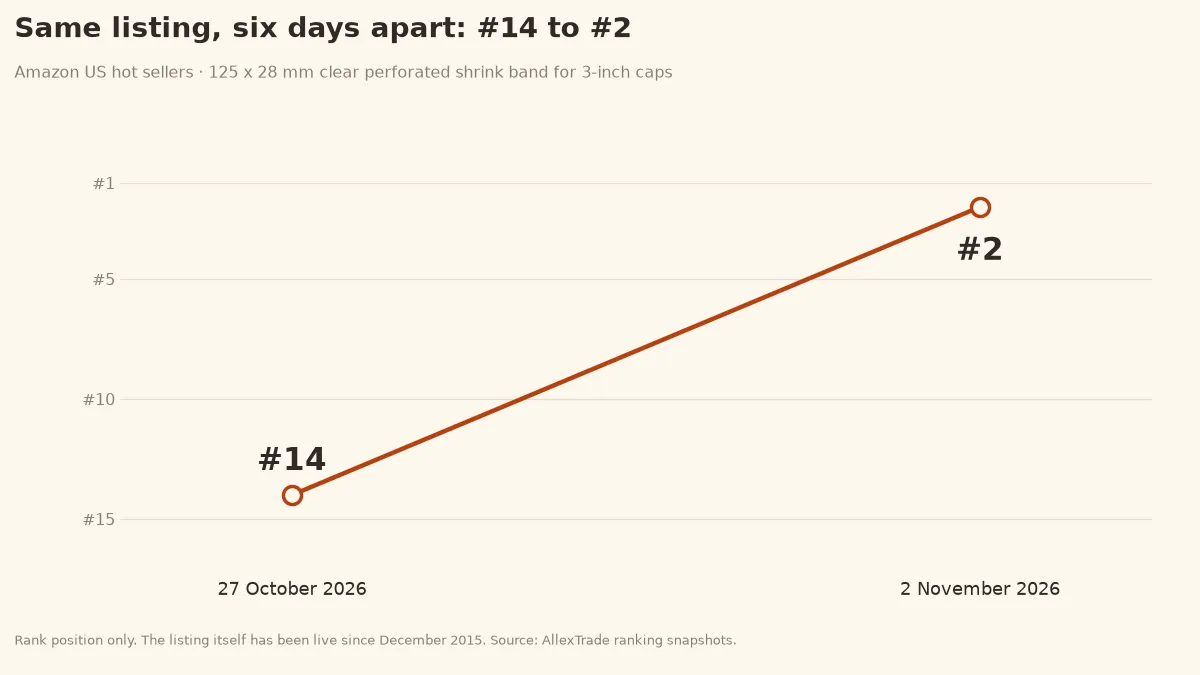
The more interesting number is not the price. It is the listing date: December 2015. This product has been selling for eleven years, and in our own snapshots it climbed from #14 on 27 October to #2 on 2 November — right as the US holiday gift-jar and home-preserving season ramps up. No spike-chasing here. Shrink bands are a packaging consumable: every jar you sell needs one, every order repeats, and the buyer who finds a good band supplier keeps them for years. That makes it one of the quietest, most durable businesses in the entire packaging aisle — and one of the easiest products to source badly.
This article covers what the band actually does, how to size it, how PVC and PETG differ, what "perforated" means for the opening experience, what paperwork to ask for, and a sample checklist you can run with a heat gun and your own jars.

What the snapshot shows
The figures come from our own snapshots of the Amazon US charts. Units are the platform's trailing 30-day sold counts — an estimate, not official reporting.
| Metric | Reference listing |
|---|---|
| Product | 125 x 28 mm clear perforated shrink band, cap diameter 3", pack of 100 |
| Chart position | #2 on Amazon US hot sellers (2 November 2026 pull) |
| Same listing in our 27 October snapshot | #14 |
| Listed price | USD 124.30 (pack of 100) |
| Est. units, last 30 days | 1,402 packs |
| Listing value (units × price) | ~USD 174K per month |
| Average rating | 4.6 |
| 30-day sales vs prior month | −6% |
| First listed | December 2015 |
Three honest notes. The listing value is units multiplied by retail price — a demand-size indicator, not revenue booked, and it says nothing about margin. The −6% monthly change is a mature product wobbling, not declining off a cliff. And a single chart position can shift day to day; what does not shift is eleven years of continuous sales. You can follow this listing and the rest of the charts on our trending products page — the same product also has a dedicated shrink bands product page with the sourcing notes.
What a shrink band actually does
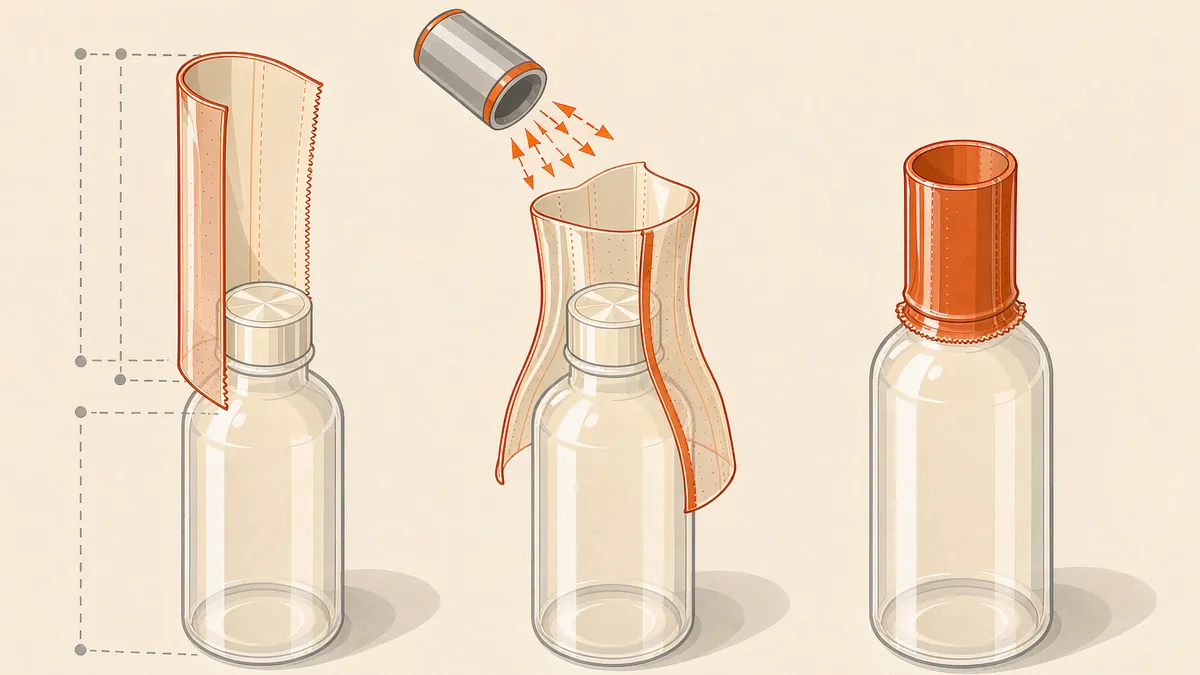
A shrink band is a pre-formed sleeve of heat-shrinkable film that slides over a closed jar's cap and neck, then shrinks tightly around both when heated. Its job is tamper evidence: the band must be torn or cut to open the jar, and a torn band cannot be discreetly restored. That is the entire value proposition — a customer can see at a glance that nobody opened the jar between the filling line and their kitchen.
Three distinctions keep buyers out of trouble:
- A band is not a hermetic seal. It provides tamper evidence, not oxygen or moisture barrier. Jarred food still relies on the lid's liner or an induction seal; many brands use both — liner for preservation, band for visible tamper evidence. Selling one as a substitute for the other is a common beginner error.
- The perforation is the user experience. A perforated band has a scored tear line so the customer can grip and peel it cleanly. An unperforated band needs scissors or a knife — which on a food jar is a small act of hostility.
- The evidence is the destruction. The band must visibly fail on first opening. A band thick enough or loosely enough shrunk that it can be slid back on is a failed design, whatever the material cost saving.
Where they are used: jams, honey, sauces, spices and supplements in glass; candles and cosmetics in tins and jars; anything where a customer's first question is "has this been opened?" Most of these sit in the kitchen and food storage category we source from China, where packaging consumables like this one ride along on every jar order.
Sizing is the product
Ask a factory for "shrink bands for jars" and you will get a follow-up question that determines everything: cap diameter, and finished band width and height. Sizing is simple geometry, and getting it right is the difference between a snug, professional-looking seal and a band that bags, splits on application, or will not come off.
The math, using the trending listing as a worked example:
- The band is supplied as a flat tube. Its flat width corresponds to half the circumference it can wrap. This listing is 125 mm flat, so its open circumference is 250 mm — an effective maximum diameter of about 80 mm.
- A 3-inch cap measures 76.2 mm. Add the cap's skirt profile and a little clearance, and the band must slide on over roughly 78–80 mm, then shrink down to grip. The 125 mm flat width does exactly that.
- Band height (28 mm here) determines coverage: it should wrap the cap's full skirt and extend a few millimetres onto the glass neck. Too short and it looks like a sticker; too tall and it interferes with the lid threads or the opening experience.
- Shrink ratio — how far the film contracts — is typically in the 40–60% range for the common materials. The band must be oversized enough to slide on and small enough to end up tight.
So your specification to a factory is: cap outer diameter (plus the cap's skirt if it flares), band flat width, band height, film thickness, material, perforated or not, printed or not. That last sentence is your RFQ. Suppliers who respond to it with precise questions about your jar are suppliers worth shortlisting.
Materials: PVC, PETG, OPS and PLA
- PVC is the category workhorse and almost certainly what the trending listing uses: lowest shrink temperature, the best conformance to awkward cap profiles, excellent clarity, lowest cost. Its drawbacks are environmental — it is chlorine-based, rarely accepted in recycling streams, and some brands and retailers are moving away from it.
- PETG is a polyester: better recyclability story (it can enter the PET stream, which is why brands with sustainability commitments ask for it by name), similar clarity, but it needs a higher shrink temperature and is slightly less conforming on complex cap shapes.
- OPS (oriented polystyrene) shrinks well and is stiff, with a recycling profile few buyers love.
- PLA and other compostable films exist for brands that need the claim; they trade heat sensitivity and shelf-life stability for the story.
Practical guidance: for a US gift-jar or food brand, PVC remains the default for cost and appearance, PETG is the upgrade that supports a recyclability claim, and the choice should be made on your brand's requirements — not on whichever film the factory happens to stock. Ask what material each quote assumes; "clear shrink band" is not a material specification.
Perforation, printing and the opening experience
The perforation line looks trivial and is not. Poorly executed perforation causes the two most common customer complaints: the band tears into confetti instead of peeling, or the perforation is so weak the band splits during shrink application. When you evaluate samples, test the tear path specifically — it should start where a thumb naturally grips and run cleanly to the bottom.
Printed bands (your logo, a "tamper evident" message, a pattern) are standard factory capability: flexographic printing, with plate costs and minimums per design. Expect printing to raise the MOQ and the unit price, and to add a proofing round — get a printed proof sample approved before production, because color on clear film behaves differently than on paper.
The paperwork conversation
A shrink band touches the cap and the neck of the jar — the outside of the package, not the food itself. But bands sit in the food-contact adjacency zone, and buyers handle this in a structured way:
- Material declarations. Ask what the film is and get it in writing, including any additives. For food products, US buyers commonly ask that materials be suitable for food-contact use consistent with the FDA's indirect food-additive framework (21 CFR Parts 174–178 covers the relevant regulations for polymers and coatings). You are asking for documentation that supports the claim — not for a certificate that says "approved," which is not how the framework works. The same discipline applies to any food-adjacent product; we walk through it in detail in our kitchen compliance guide.
- EU sales bring the food-contact materials framework (Regulation EC 1935/2004) into the conversation, with the same "documentation, not slogans" approach.
- California Prop 65 awareness applies to vinyl components; ask whether the PVC compound is formulated to avoid listed phthalates if that matters to your channel.
- Verify what you receive. A report for "similar material" is not your material's report — check the lab, the report number and the tested specimen, exactly as you would for a test report on any other product. And the usual caveat: this is sourcing guidance, not legal advice; confirm requirements for your specific product and market with a professional where the stakes justify it.
What drives price and MOQ
- Film weight. A 125 × 28 mm band at typical thickness weighs around 0.2 g. Price scales with film area and thickness — wider bands for larger caps cost proportionally more.
- Printing. Adds plate cost, per-color pricing and minimums.
- Bagging. The trending listing sells 100 per pack; consumer-facing packs add bagging labor and packaging versus bulk cartons for production lines.
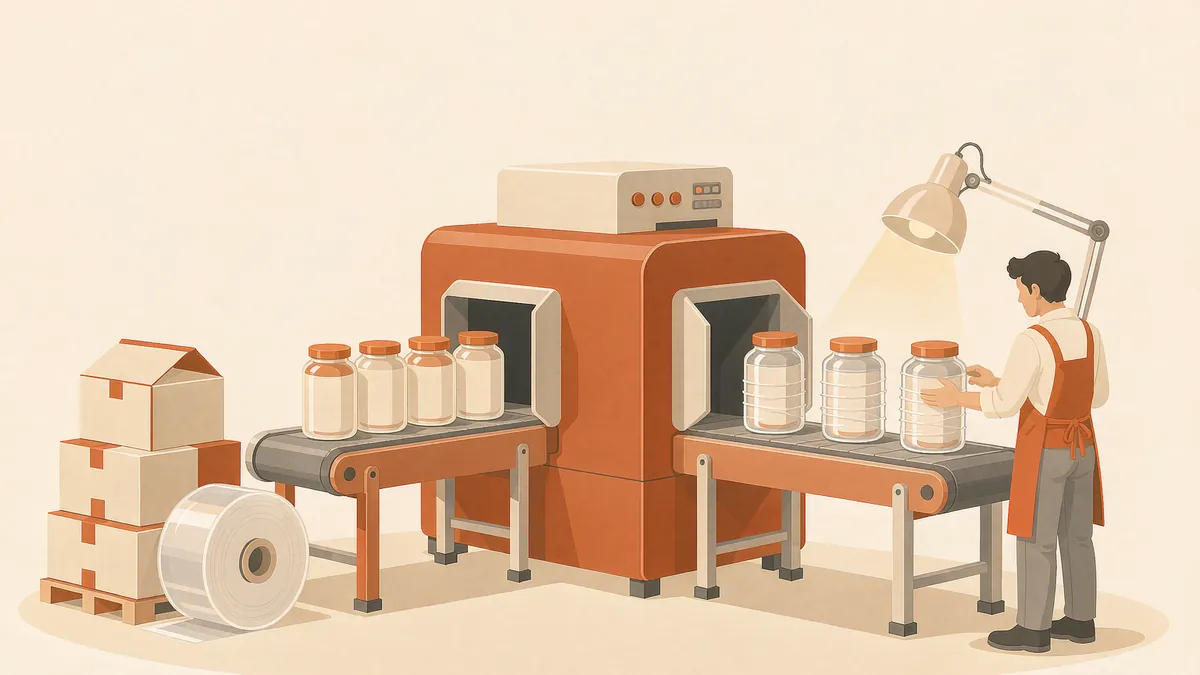
- Rolls vs pre-cut sleeves. Pre-cut bands cost more per unit and save application labor; roll stock fed through an applicator is cheaper at volume. Match the format to how your jars are actually packed.
- MOQ. Unprinted bands commonly start in the thousands of pieces per size; printed bands run higher because of plates and setup. See how to choose the right MOQ before you commit to a size you may outgrow.
Freight and storage — the part nobody plans for
Shrink bands are light but bulky, and they have one genuine vulnerability: heat. PVC films can distort in a hot container or warehouse, which is why bands should ship and store cool and be sampled well before your peak season, not during it. Vacuum-compressed or neatly nested packing reduces carton count; ask suppliers to quote carton dimensions per 10,000 bands so you can compare freight properly, not just unit prices.
A sample checklist you can run yourself
- Slide the band onto your actual jar and cap — not a similar one. Check that it goes on without force and sits square.
- Shrink it with a heat gun, rotating evenly. Watch for wrinkles, burns, or a split seam. Then compare with a proper heat tunnel result if you have access.
- Check the shrink's memory after 24 hours — a band that relaxes and loosens overnight was undersized or under-shrunk.
- Grip and tear along the perforation ten times. Clean peel, or confetti?
- Try to slide the torn band back onto the jar. If you can, the tamper evidence has failed.
- Judge clarity on the filled jar — haze shows on amber contents.
- If printed: check registration on both sides and the readability of any text.
- Store samples in a hot car for an afternoon, then re-test fit and clarity. Heat damage you discover now is a claim you avoid later.
No sample passes everything on the first round. What matters is which failures appear, whether the factory can explain them, and what they change before production.
Frequently asked questions
What size shrink band do I need for a 3-inch cap? Flat width = half the circumference. A 3-inch (76.2 mm) cap needs an open circumference of roughly 250 mm including clearance, which is a 125 mm flat width — exactly what the trending listing uses. Add the cap skirt height plus a few millimetres of glass coverage for band height. Measure your actual cap before ordering anything.
PVC or PETG for food jars? PVC is cheaper, shrinks at lower temperature and conforms better; PETG supports a recyclability claim and enters the PET stream more readily. Both are widely used. Decide based on your brand requirements and get the material declaration in writing — the paperwork matters as much as the polymer.
Can shrink bands be printed with my logo? Yes — flexographic printing with plate costs and per-color pricing. Expect higher MOQs than unprinted bands and approve a printed proof sample before production.
Do shrink bands replace an induction liner? No. The band provides visible tamper evidence; the liner provides the hermetic seal that protects the contents. Many brands use both. Selling a band as a seal is a beginner error that shows up as spoilage claims.
Ready to source?
Looking for a reliable supplier for your shrink band or packaging project? Send us your product reference, target market and estimated order quantity through our sourcing service — AllexTrade can help you explore suitable supplier options, compare quotations and arrange samples where available. You get a reply within 24 hours and screened supplier options with quotes typically in 3–5 business days, or bring the product straight to the quote form and we will take it from there.
Small batch? That's our specialty.
AllexTrade negotiates low-MOQ production across screened factories. Tell us your product and target quantity and we'll come back with realistic options and prices — timing depends on how quickly suppliers respond.