
Send the same product request to six suppliers and you will usually get back something stranger than six different prices: four different products. One quotation arrives EXW from a factory two hours inland, another FOB from a port city, a third excludes the retail box, a fourth assumes a lighter material gauge than the one in your reference photo. The numbers are not comparable because the questions were not identical — and the differences stay invisible until they surface later as a surprise freight bill, a packaging dispute, or a container that holds fewer units than your spreadsheet promised.
This is the middle stage of contacting Chinese manufacturers, and it is where most of the value leaks out. Our guide on how to contact Chinese factories covers how to write a first message that actually gets answered, and reading a sample versus bulk quotation covers how to audit the numbers once one arrives. This guide covers the stretch between the two: how to give suppliers a request complete enough that they quote the same product, and what a quotation must contain before it is worth comparing. (If you are still choosing the product rather than sourcing it, start with our pillar guide on discovering new products in China.)
The core idea fits in one line: a quotation is an answer, and the quality of an answer is capped by the quality of the question.

Why Five Quotes for the Same Product Are Rarely Comparable
When your request leaves a variable unstated, every supplier fills the gap with a default, and defaults differ between factories — material grade, sheet thickness, packaging structure, units per carton, delivery term, payment terms, the starting condition of the lead time. Each free variable is a chance for two honest suppliers to produce two different numbers for the same order. None of it is deception; quoting is estimation under uncertainty. But the effect on your side is the same: unit prices that differ for reasons unrelated to supplier efficiency, so you cannot tell a well-run factory from a cheap-looking quotation.
The gaps are rarely exotic: a thinner gauge of steel, a lighter grade of plastic, a plain poly bag instead of the retail box, one fewer unit per carton, a price quoted per piece when you meant per set. Two quotes a few cents apart can be the same product with different packaging assumptions, and a dollar-wide gap can be one unstated material change. Until you control the inputs, the spread in your price table is mostly noise.
What an RFQ Is — and What It Is Not
A first-contact message and a request for quotation are different tools. The first message is short, built to earn a reply. The RFQ is a small package, built to earn a comparable quotation, and it goes only to suppliers who have already confirmed they make this kind of product — the document is worth something, and it belongs on a shortlist, not sprayed across fifty inboxes.
A workable RFQ package has five parts:
- A short cover note — who you are, your market, your real quantity.
- A one-page specification sheet — the document that does most of the work, detailed below.
- Reference images — the product, and ideally the packaging you expect.
- A response template — the exact fields you want back, so every supplier answers in the same shape.
- A stated deadline — one date, the same for everyone.
One product per RFQ: a request covering five products gets five shallow answers, while one precise request gets the kind of answer you can build an order on.
The Specification: Close Every Gap You Can Afford To
The spec sheet is where comparability is won or lost. It does not need to read like an engineering drawing, but every line should remove a decision the factory would otherwise make for you:
- Material and grade. Not "stainless steel" but which grade — 304 and 201, for example, differ in corrosion behavior and price. Not "plastic" but which polymer family, and for food or skin contact, which grade is claimed.
- Dimensions with tolerances. Nominal size plus the range you will accept; a tolerance you never state is one the factory will choose for you.
- Thickness or gauge. The most common hidden variable in hard goods; state it as a number.
- Finish and color. Brushed, matte, glossy; a Pantone reference rather than "same as the photo", plus how much variation you accept.
- Weight. A quiet guard against material substitution — hard to fake, easy to check on arrival.
- Construction and function. How parts join and what must not happen there, what the product must do, and how it will be checked — a load, a cycle count, a test you can run on the sample.
- Branding method. Laser etching, printing and embossing are different processes with different tooling; name the method and the position.
A spec-sheet line might read: "304 stainless steel, brushed finish, 0.8 mm; polypropylene reverse side; 38 × 28 cm, ±3 mm; welded seam must not trap water; logo laser-etched lower corner" — the numbers here are illustrative, but the format is the point. We maintain a full market and sourcing page for the stainless steel and PP double-sided cutting board, and its spec checklist shows this level of detail filled in for a real product.
The phrases below transfer decisions to the factory without you noticing — each one reads fine and quotes badly:
| You write | What the factory decides for you | What to write instead |
|---|---|---|
| "good quality" | Whatever the target price allows | Measurable criteria: grade, thickness, finish |
| "food grade" | The cheapest polymer they can defend verbally | Named material, plus the documentation you need — confirmed per product and market |
| "same as the photo" | What the photo looks like from their angle | Photo plus written dimensions and materials |
| "nice packaging" | A plain carton, possibly no retail box | Structure, material, print colors, finish |
Quantity: The Real Number, Plus One Tier
Give your honest first-order quantity — inflated numbers collapse at the sample stage anyway, as our guide on contacting factories explains. Then ask for a quotation at one tier above your real quantity as well. The price curve shows how the factory thinks: a steep drop usually means setup costs dominate, a flat curve means material costs dominate. Tiered prices also reveal whether the MOQ is a wall or a step — a minimum caused by a carton print run is negotiable, a production constraint is not. And asking for tiers in the same RFQ is free; chasing them by email takes weeks.
Be specific about what the MOQ attaches to: a 500-piece minimum can mean 500 per order, per color or per size — three very different commitments for a product sold in variants. Ask which one it is, and what drives the next price break; the answer tells you where the real cost step is.
Your quantity should also come from somewhere better than a guess. Even a rough snapshot of how the category sells on your target marketplace turns the question from "what sounds believable" into "how many weeks of cover a first order should buy." The figure below is the demand reference for this guide's worked example.

Market, Compliance and Documents
Name your market in one line — it silently changes packaging, voltage, labeling and materials — then be precise about what you ask. The most common mistake is asking a compliance question the factory cannot properly answer, such as "is it FDA approved?" US food-contact materials are governed by a regulatory framework, not a product approval, so the meaningful questions are about materials and documentation: which material exactly, and which declarations or test reports the supplier holds, and against which standard. Elsewhere the logic repeats — electronics test reports are model-specific, so an old report for a similar product is not a report for yours, and children's products carry stricter testing the factory may not hold at all.
So put documentation requests in the RFQ as questions, not as expectations:
- Which materials and grades does the quotation assume?
- What documentation do you hold for those materials, and for which standards?
- Which markings and labels does the product need for my market — and which of those can you apply?
Treat any variation of "our products pass all certifications" as a sales sentence, not a document. This section is orientation only — requirements differ by product and destination country — and our food-contact compliance checklist covers the verification questions in more depth. This is not legal advice; confirm the specifics for your product and market.
Packaging: The Half of the Quote Buyers Forget to Specify
Packaging is the most under-specified block in most RFQs, and it moves two costs at once: the unit price and the logistics bill. A quotation that excludes retail packaging is not comparable to one that includes it.
- Retail packaging — structure, material, print colors, finish, and who supplies artwork and dielines. If packaging needs its own tooling, cost it as a separate one-time line, like product tooling.
- Master carton — units per carton, carton dimensions and gross weight: the three numbers behind your shipped volume, your freight quote and marketplace fee estimates.
- Labels — which barcode your channel needs and where it goes, the origin marking, the language of warning text.
- Protection — poly bag, desiccant, corner protection, and whether the packaging must survive a defined drop-test protocol such as ISTA 1A — worth naming for anything heavy or headed straight to consumers.
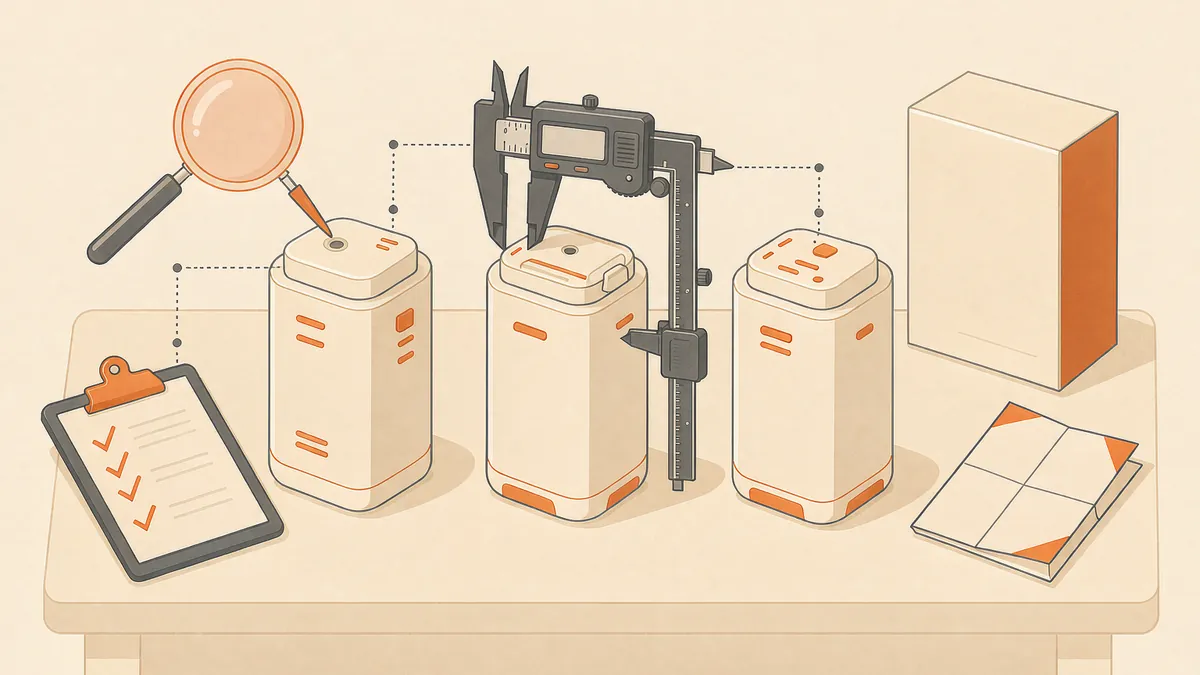
Packaging decisions need not be final before you request quotations — a written placeholder spec, the same for every supplier, is enough. But it must be written down, or the packaging costs in your comparison are fiction.
Fix the Commercial Frame Before the Price Arrives
Comparability is not only about the product. The commercial terms below should be fixed in the RFQ, not negotiated quote by quote afterward:
- One delivery term for everyone — FOB a named port is a common basis; EXW quotes from suppliers far inland are not comparable. Ask each supplier to name their port.
- Payment terms — a deposit with balance later is common for first orders, but the split is negotiated per supplier; comparability needs only that every price assumes the same kind of terms.
- Lead time and its starting condition — a day count is meaningless until you know the clock: deposit received, artwork approved, sample signed.
- Quotation validity — material prices move; ask how long the price holds. Suppliers who answer in weeks rather than months are watching their input costs.
- Tooling — a separate one-time line, who owns the tool once paid, and whether it is credited at some volume. Ownership determines whether you can ever move the product elsewhere.
- Samples — cost, courier, lead time, and whether the fee is credited against the first order.
Ask for the Answer in Your Shape: The Response Template
The cheapest way to make five quotations comparable is to ask for the answer in your shape: paste a small table into the RFQ and request the quotation be returned with these fields filled. Good suppliers comply readily, because the template is easy to fill and costs nothing. Send the identical package, with the same deadline, to every shortlisted supplier — and if one supplier's clarifying question changes the answer, update the spec sheet and resend it to everyone. It feels slow; it is the only way the comparison stays honest. The fields:
| Field | A usable answer contains | A warning sign |
|---|---|---|
| Unit price per tier | A price at each quantity tier you asked | One number, no quantity basis |
| Delivery term and port | "FOB, [named port]" | A bare price with no term |
| Tooling | One-time cost, separate line, ownership stated | Folded silently into the unit price |
| Packaging | Per-unit cost, plus any packaging tooling | "Included" with no description of what it is |
| Production lead time | Days, plus what starts the count | A number with no basis |
| Quote validity and MOQ basis | A validity date; MOQ per order, color or size — named | Nothing stated; one number covering everything |
How to interrogate the answers — hidden cost lines, red flags, the comparison table you build — is its own skill; our quotation-reading guide covers that side in depth. The template only gets the fields returned; reading them well is the next step.
Why a Same-Day Quotation Is Usually Not a Quotation
Turnaround time is information. If your RFQ matches an existing catalog product with no changes, a fast quote is plausible — the price already exists. But a custom specification requires someone to check material availability, ask the workshop about tooling and cost the packaging, which commonly takes a few business days; complex multi-part products take longer.
A quotation that arrives in two hours for a custom specification almost always means the supplier priced a catalog item or guessed — numbers that look precise and are not. One question separates the two cases, and it is worth sending to every supplier that quotes quickly: which parts of my specification did you price exactly as written, and which did you assume? A supplier who answers precisely is worth keeping even if the price is imperfect; one who cannot has given you a reflex, not a quotation.
Scoring the Quotes You Get Back
When the responses arrive, resist the urge to sort by price. A five-minute completeness pass gives you a far better shortlist:
- Count the fields — how many template fields came back filled and how many assumptions were declared. Completeness predicts how the supplier will handle paperwork during production.
- Normalize before comparing — same tier, same delivery term, packaging included, tooling excluded. Quotes that fail this get converted or excluded, never mentally adjusted.
- Compare delivered cost per sellable unit, not the unit-price line; freight, duties, packaging and defect allowance change the ranking more often than buyers expect.
- Never fill a blank yourself — if a field is missing, ask for it. Guessing builds your decision on your own assumption, not the supplier's.
- Write a one-page decision note — confirmed, assumed, not yet known. The third column is where your sample plan and deposit timing come from.
Two or three suppliers usually survive this pass. Sample them against the same written criteria — evaluating a product sample before a bulk order picks up exactly there — and the final comparison is between real options, not three different products.
How AllexTrade Handles This Stage
AllexTrade is a China product discovery and sourcing service — not a marketplace and not a training course. This stage maps onto our four core services: exploring products and manufacturers that fit your requirements, organizing supplier information so options can be compared before anyone commits, collecting quotations, MOQs and supply terms into a genuinely comparable side-by-side format, and coordinating sample requests while specifications and packaging are clarified with suppliers. You always receive what still needs confirmation before you commit, and any fees beyond the free initial review are confirmed in writing first. What happens after a sourcing request walks through the first weeks of an engagement.
Have a product in mind and want quotations you can actually compare? Send your product reference, target market and estimated quantity through our sourcing request form — we reply within 24 hours — or read more about how the service works. Supplier options and quotations are typically organized within 3–5 business days of a confirmed request. If your product is kitchen or food-storage related, browse the kitchen and food storage category for more products that reward this kind of specification discipline.
Frequently Asked Questions
How long does a Chinese manufacturer take to send a quotation? A stock item against a standard specification can be quoted the same day. A custom specification usually takes a few business days — materials, tooling and packaging have to be checked — and complex products take longer. A same-day reply to a custom RFQ usually means a catalog price or assumptions; ask which parts of your specification were priced exactly as written.
What should an RFQ to a Chinese factory include? A one-page specification (materials and grades, dimensions with tolerances, finish, color reference), your real quantity plus one higher tier, your target market with the documentation you need, a packaging brief with master-carton details, the commercial frame (delivery term, payment terms, quote validity), the response fields you want back, and a stated deadline.
How many supplier quotations do I need before comparing? At least two, and ideally three or four — all quoted on the same specification, quantity and delivery term. A single quotation tells you nothing, because there is no way to distinguish a market price from a padded one.
Should I tell a Chinese supplier my target price? A range is more useful than silence or a single number. A realistic range tells the factory whether to quote seriously or explain what is achievable at your volume; an unrealistically low range mostly gets you quietly dropped. Give a range before you start negotiating.
What if a supplier will not fill in my quotation template? Ask for the missing fields in a plain email — some factories simply prefer their own format. If a supplier still will not state the delivery term, tooling ownership, validity period or lead-time basis, treat it as a preview of the paperwork you would get during production.
Small batch? That's our specialty.
AllexTrade negotiates low-MOQ production across screened factories. Tell us your product and target quantity and we'll come back with realistic options and prices — timing depends on how quickly suppliers respond.