
Every category has its hype cycle, but outdoor and fishing gear has something extra: a calendar. A duck decoy that sells beautifully in October can sit dead by January, and a paddle-sports accessory that looks like a movement in July is often a commodity price war by September. That calendar is also why this category punishes lazy sourcing more than most — you are not just buying a product, you are buying a season, and if the container arrives after the season opens, no discount recovers the loss.
This guide is for sellers building an outdoor or fishing line from China — rods and reel combos, tackle storage, decoys and calls, camping and paddling accessories, dry bags, landing nets — who want to separate products with a durable story from products riding a seasonal spike. It covers what innovation actually means in this category, what our own US snapshot data shows right now, the specifications and compliance checks that decide returns, and how to find the suppliers behind genuinely new products rather than catalog reprints. For the broader method, our pillar guide on discovering new products in China covers the full funnel from signal to sourcing request.
What "Innovative" Actually Means in This Category
The word gets attached to anything with a new colorway, but in outdoor and fishing gear, four kinds of innovation consistently produce sellable products — and none of them is a new color.
Platform accessories. When a new device sells millions of units, its owners immediately need mounts, cases, and carry solutions. A rugged carry case for a portable satellite internet terminal is a current example: the device is expensive and owners protect it. Our November 2026 snapshot shows a Starlink Mini carry case sitting on the Amazon US hot-sell list with 1,724 units sold at $27.00 — a product that exists only because the platform it serves exists. Platform accessories have a clock too, but it runs on the platform's install base, not on weather.
Failure-point engineering. The most durable innovation in this category is boring: a reel with a sealed drag that survives saltwater, a dry bag with a welded seam instead of a stitched one, a landing net with a fold that does not pinch the line. These products do not trend; they accumulate reviews. When a competitor's 1-star reviews cluster on one failure mode — leaking seams, bent shafts, rusted hooks — a supplier who solves exactly that failure has a real product.
Format changes. Packable versions of bulky gear — telescopic rods, collapsible buckets, flat-packing chairs — keep earning shelf space because they solve a transport problem for kayak anglers, backpackers, and anyone with a small car. The engineering risk is that folding mechanisms are where cheap versions fail, which is why format innovation must be sampled, not screenshotted.
Kit and bundle innovation. A shore-fishing kit, a kayak tackle tray set, a camp-kitchen bundle — bundles raise order value, but each component adds a failure point and a supplier. The kit is only as strong as its weakest item, and unlike electronics accessories, outdoor kits get used hard in sand, salt, and rain.
What does not count as innovation: a fish-shaped lure with a new paint job, a "premium" rod with a higher model number and the same blank, anything whose only proof is an influencer video. Which brings us to what the data actually shows right now.
What the Current US Snapshot Says
We track daily snapshots of what is moving on Amazon US and TikTok Shop US. Pulled on November 4, 2026, the outdoor and fishing-adjacent items on the current lists look like this:
| Product | List | Price | Units sold | 30-day growth | Opportunity score |
|---|---|---|---|---|---|
| Duck hunting decoys (waterfowl set) | Amazon · Improve | $101.40 | 2,613 | -50% | 70 |
| Running armband for phones | Amazon · Improve | $68.00 | 5,459 | 0% | 69 |
| Kids rain poncho 2-pack | Amazon · Growth | $10.00 | 264 | +1000% | 47 |
| Starlink Mini carry case | Amazon · Hot sell | $27.00 | 1,724 | no trend data | 47 |
| Pickleball paddle (carbon face) | TikTok Shop · Hot sell | $8.40 | 117 | -36% | 31 |
| Inflatable battle bunker (26'×20') | Amazon · New arrival | $1,300.00 | 1 | 0% | 31 |
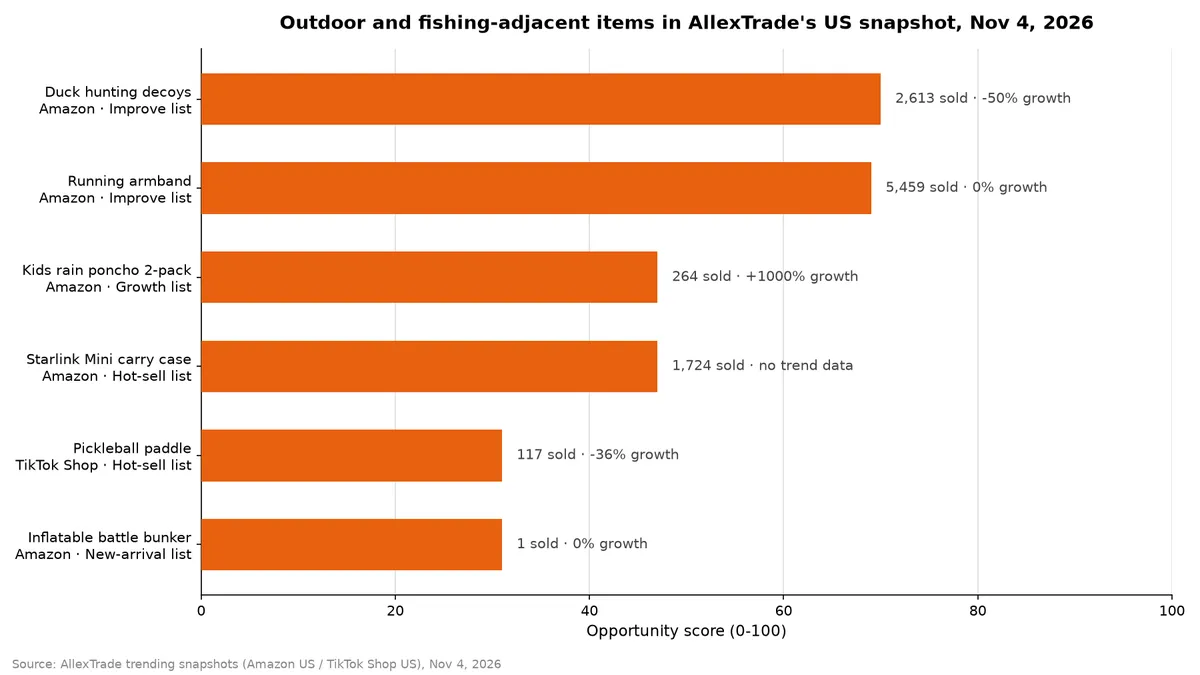
Read together, these six rows are a short course in reading outdoor data honestly:
- The duck decoys at -50% are not failing. They are a $101 seasonal product photographed mid-season-decline in November, exactly when waterfowl demand normalizes after the opener rush. An opportunity score of 70 with 2,613 units sold says the category is healthy; the growth number tells you when the window closes.
- The $8.40 carbon-face pickleball paddle is the cautionary tale. Pickleball was the breakout category of recent seasons, and this listing shows where commodity versions end up: a collapse-to-the-floor price, 117 units, and -36% growth. When a hyped outdoor category commoditizes, it commoditizes fast, and the survivors are brands with real differentiation — not importer #400 with the same mold.
- The kids' rain poncho at +1000% is seasonal demand doing what it does. A $10 item, 264 units, explosive growth — and a product you cannot chase, because by the time you source it, the rainy season it rode in on is over. Spike products are signals to study, not orders to place.
- The $1,300 inflatable bunker with 1 unit sold is a niche novelty. High-ticket, event-driven, and completely unforgiving on returns and freight. It is on this list to remind you that "new and innovative" and "worth importing" are different judgments.
The pattern across all six: units sold and opportunity score describe the category; growth tells you which week of the season you are looking at. Neither number alone justifies a purchase order. If your sourcing process starts from trend signals, our guide on finding winning products before sourcing covers how to qualify a signal before money moves.
The Seasonality Clock — and the Lead Time Math
Outdoor and fishing demand in the US runs on three overlapping calendars: spring fishing openers (roughly March–June by region), summer camping and paddling (June–August), and fall hunting seasons plus holiday gift gear (September–December). Your product must land before its window opens, which means working backward:
- Production after sample approval: commonly 30–45 days for stocked-component goods, longer if tooling is new.
- Ocean freight to the US plus customs clearance: plan 30–40 days door-to-door on a normal schedule; peak-season congestion adds more.
- Amazon check-in or warehouse intake: another 1–2 weeks before the listing is buyable.
Stack those up and a product that needs to sell in early April must be ordered around January. This is why seasoned outdoor sellers place production orders in the off-season — prices are better, factory schedules are open, and the container lands with weeks to spare. It is also why the mid-season reorder decision matters: reorder too late and you miss the peak; reorder on last month's growth rate and the decoy chart above shows you what happens when the curve turns.
One more calendar trap: fishing and hunting regulations and season dates change by state and by year. A product tied to a specific technique or species should be checked against current rules in your top sales states before you commit to inventory quantities.
Specifications That Decide Returns
Outdoor gear returns are rarely about shipping damage. They come from products meeting conditions the supplier never tested for. These are the spec conversations to have before samples ship:
Corrosion. Freshwater is easy; saltwater is the real market. Ask which stainless grade is used on hooks, rings, guides, and fasteners — 304 stainless stains in salt spray, 316 is the marine-grade answer for anything regularly wet with seawater. For aluminum parts (reel seats, rod blanks, pole tips), ask whether the finish is anodized and how thick; painted aluminum on a saltwater product will bubble within a season. This single question separates freshwater-supplier quotes from marine-grade ones.
Water exposure ratings. "Waterproof" is a claim, IPX ratings are a testable standard — but verify which rating the product actually passed and against what test. IPX4 (splashes) and IPX7 (submersion) are different products wearing similar marketing. For dry bags, ask about the closure system and seam construction: welded RF seams versus stitched-and-taped tells you the price tier before you open the quote.
UV and material aging. Plastics left on a boat deck or a beach age fast. ABS yellows and embrittles under UV; ASA and UV-stabilized polypropylene hold up much better. Fabric products — ponchos, waders, awnings — should have a UV-stabilization spec and a denier figure you can verify. "UV-resistant" written on a quotation sheet is a claim; ask for the material grade and test basis.
Mechanical honesty. In reels, ball-bearing count is marketing; drag rating, gear material (brass versus zinc), and sealed-body construction are the real spec sheet. In rods, the model name means nothing; the blank material (fiberglass versus carbon, and the carbon's modulus), guide quality, and reel-seat fit are checkable. Ask suppliers for the spec sheet, not the listing copy — and if they cannot produce one, that is itself the answer.
Cold and load behavior. Gear used in early-season mornings or northern states gets cold. Plastics that flex fine at room temperature crack near freezing, and adhesives let go. If your market includes cold regions, ask for low-temperature behavior on any load-bearing plastic part, and test the sample from your own freezer, not from the supplier's spec sheet.
Compliance Checks Before You Commit
Outdoor and fishing gear sits across several US regulatory zones, and the rules depend on what the product is and who uses it. Treat this section as orientation, not legal advice — confirm requirements for your exact SKU and destination with the applicable authority or a compliance consultant.
- Fishing tackle and lead. Tackle itself is lightly regulated federally, but several US states restrict lead fishing sinkers and jigs, particularly where loons and waterbirds are a concern, and some marketplace or park rules go further. If your line includes lead weights, check the rules in your top sales states — or source bismuth, tin, or steel alternatives and make it a selling point.
- Flotation products. Anything marketed as a life jacket or personal flotation device is regulated by the US Coast Guard, and approval is a documented, model-specific process. Never write "USCG approved" on a listing or a carton without the certificate in hand — and consider whether you want to be in that category at all as a first product.
- Helmets and ride-on gear. Bicycle helmets fall under CPSC requirements (16 CFR 1203). If your outdoor line includes helmets for cycling, skating, or paddling, certification is not optional.
- Fuel and pressurized items. Camp stoves, fuel canisters, and inflators can classify as dangerous goods for transport. Pressurized canisters have their own shipping restrictions and are often the reason a quote suddenly includes "special freight".
- Children's products. Any outdoor item marketed to children — the kids' poncho in our snapshot table, kids' rod combos, life vests for children — falls under CPSIA testing and labeling requirements.
- California Prop 65. Soft plastics, vinyl dry bags, and coated fabrics can implicate phthalate limits. Prop 65 warnings are a labeling and liability question, not a federal ban — but settlements in this space are common enough to plan for.
A supplier who can name which of these apply to your SKU and produce the corresponding documents is worth shortlisting. One who says "all certified, don't worry" has just told you who will disappear when a compliance letter arrives. Our guide on verifying a Chinese factory before you order covers the document checks in detail.
How to Find the Suppliers Behind Real Innovation
Catalog sites surface the products everyone already has. The suppliers behind genuinely new outdoor products are usually found through three doors:
Trade show exhibitor lists. ICAST (fishing tackle), Outdoor Retailer (camping and paddling), and IWA OutdoorClassics (Europe) publish exhibitor directories, and Chinese manufacturers exhibit at all of them. The exhibitor list is a free, current map of who actually develops products in each niche — even if you never attend, the list itself is the research shortcut.
Patent and design searches. A genuinely new mechanism usually has a patent or design registration behind it. Search Google Patents and the relevant national registries for the mechanism keyword, and note who the assignee is. If a factory claims "our own design", this is how you confirm it — and how you avoid importing into someone else's registered design.
The mold question. When you contact a factory, ask directly: "What new molds did you cut in the last 12 months, and which categories are they in?" A factory that tooling new products will answer with specifics; a repackager will change the subject to their catalog. This single question filters more efficiently than any certification badge.
Once you have candidates, the sample protocol for outdoor gear is different from electronics: field-test it. Fish with the reel in saltwater for a weekend. Leave the dry bag submerged overnight. Freeze the folding stool hinge, then load it. Keep the sample, photograph every failure, and send the annotated list back — how a supplier responds to a defect list tells you more than the sample itself. We keep the full method in our guide on evaluating product samples before a bulk order.
Tooling, MOQ and How to Start Small
Innovation has a price in tooling. A new injection mold for a tackle tray, lure body, or bucktail head commonly runs from a few thousand dollars into five figures depending on size and cavity count, and the factory will want that exposure covered — which is why custom-tooled products carry high MOQs.
There are three standard ways to start smaller without giving up on a new product:
- Existing mold, custom finish. Take a factory's existing body and invest in custom colors, packaging, and a small hardware change. You get differentiation at a fraction of the tooling cost and MOQ.
- Soft goods first. Dry bags, ponchos, gear ties, and rod sleeves are cut-and-sewn products with far lower tooling barriers than injection-molded hard goods — most customization is material, color, and branding.
- Shared tooling, exclusive market. Some factories will run a mold you co-fund with exclusivity limited to your market (for example, US only). Get the exclusivity terms in writing, including which SKUs and which territories.
Whatever route you take, treat MOQ as a per-SKU, per-configuration number confirmed in writing — color counts, packaging variants, and kit composition all move it.
How AllexTrade Sources This Category
AllexTrade is a China product discovery and sourcing service. For an outdoor or fishing line, that means:
- Product discovery: you bring the season and the positioning, and we surface candidate products with current US snapshot data attached.
- Supplier sourcing: we identify factories — including marine-grade and cut-and-sew specialists — plus screened trading partners, and approach them with your specification.
- Specification and matching: corrosion grades, IP ratings, material specs, and compliance documents translated into a sheet suppliers can quote against.
- Quotations and MOQ: comparable quotes per configuration, with tooling costs broken out separately.
- Samples and quality checks: field-test sample coordination, pre-shipment inspection against your checklist.
- Production and delivery: production order, export logistics, and delivery timed to your season window.
Send your product reference, target market, and estimated quantity through our sourcing request form — we reply within 24 hours, and quotes typically arrive within 3–5 business days. You can also browse related categories such as home and outdoor living, or read how the service works.
Frequently Asked Questions
What outdoor products sell well from China right now? Based on our November 2026 US snapshot: platform accessories (like carry cases for satellite internet terminals) and seasonal hardware (waterfowl decoys at $101 average with thousands of units sold) are the healthy segments, while commoditized paddle-sports gear has collapsed to commodity pricing. The lesson is to source categories with engineering or platform differentiation, not raw trend heat.
How early should I order seasonal outdoor gear from China? Work backward from the season: 30–45 days production plus 30–40 days ocean freight and clearance plus 1–2 weeks intake means a spring fishing product should be ordered in January. Ordering in the off-season also gets better factory pricing and scheduling.
What specifications matter most for saltwater fishing gear? Stainless grade (316 for regularly-wetted parts), anodized rather than painted aluminum, sealed drag and gear material in reels, and welded seams in fabric products. These four conversations filter freshwater-grade suppliers from genuine marine-grade ones faster than any certificate.
Are lead fishing sinkers legal to sell in the US? Federally, tackle is lightly regulated, but several US states restrict lead sinkers and jigs to protect waterbirds, and rules vary by state and change over time. Check the regulations in your top sales states, or source tin, bismuth, or steel alternatives — this is orientation, not legal advice, so confirm current rules before committing.
What MOQ should I expect for innovative outdoor products? It depends on tooling: products using a factory's existing molds can start at accessible MOQs with custom color and packaging, while a new injection mold pushes MOQ into the hundreds or thousands to amortize tooling. Confirm MOQ per SKU and configuration in writing, including packaging variants.
Small batch? That's our specialty.
AllexTrade negotiates low-MOQ production across screened factories. Tell us your product and target quantity and we'll come back with realistic options and prices — timing depends on how quickly suppliers respond.