
Most sourcing advice starts at the marketplace listing, but the expensive mistakes happen earlier and later than that: earlier, when a buyer searches for suppliers and mistakes volume for choice; later, when a supplier who looked fine in chat turns out to be a repackager with no factory, no compliance documents, and no way to fix a defect. "Vetting" is the discipline that closes both gaps — and unlike finding suppliers or contacting them, almost nobody does it systematically.
This guide is the operational core of that discipline: how to build a real candidate list, what to score when responses come in, which documents to request, how to use samples as evaluation rather than confirmation, and the red flags that should end a conversation. It connects three guides you may have already read — finding reliable Chinese suppliers, contacting Chinese factories, and verifying a supplier before an order — into one sequence you can actually run. If you only have time for one checklist before your next order, this is the one.

Where Vetting Fits: Search, Contact, Evaluate, Sample, Order
Each stage has a different goal, and mixing them up is where buyers lose money:
- Search produces a candidate list. Goal: 8–10 plausible names, not one "perfect" supplier.
- Contact produces responses. Goal: information, not a relationship.
- Evaluate (this guide's center of gravity) produces a shortlist. Goal: evidence.
- Sample tests the shortlist against reality. Goal: data from your own hands.
- Order starts the relationship. Goal: terms in writing before money moves.
The most common failure is skipping the evaluate stage — going from "they replied nicely" straight to a deposit. The second most common is evaluating everyone the same way, when a $2,000 trial order and a $200,000 annual program deserve different depths of checking. Scale the process below to the money at risk.
Step 1: Build a Candidate List From More Than One Channel
A candidate list built from a single marketplace search has a systematic bias: it over-represents suppliers who are good at marketplace listings. That is a real skill, but it is not the same skill as making your product well. Pull candidates from at least three of these:
- B2B marketplaces — the fastest channel and fine as a base layer; note whether each profile says "manufacturer" or "trading company" and treat the self-description as a claim to test, not a fact.
- Trade show exhibitor lists — ICAST for fishing, Canton Fair phases, category-specific shows; exhibitor directories are public and current, and exhibiting companies have already passed a basic seriousness filter.
- Referrals from adjacent buyers — a non-competing brand in a nearby category can hand you a factory name in one message.
- Industry association and cluster directories — many Chinese product categories have geographic clusters and association member lists that never appear on page one of a marketplace.
Eight to ten candidates is the practical target: enough to compare quotes meaningfully, few enough that each gets a real conversation.
Step 2: Score the First Contact — It Is Already Evidence
The first exchange tells you more than most buyers realize. You are not judging English quality; you are judging specificity, and you can score it the same day:
- Do they answer the question you asked? Ask three specific questions (one technical, one capacity, one documentary). A supplier who answers all three specifically is different from one who replies with a catalog and "welcome to visit our factory".
- Do they know their own product? Ask what they would change about their best-selling version and why. Manufacturers answer from production experience; repackagers answer from listings.
- How fast and how stable is the reply? Speed alone means little, but a supplier whose response quality collapses after the first message is telling you what support will feel like month three.
- Do they ask you anything? A serious factory asks about your market, volumes, and use case, because those change what they would offer. Silence is a lead-scoring gift.
For message templates and opening strategy, our guide on first messages that get replies covers the contact stage in full.
Step 3: Run the Scorecard — Ten Checks, Weighted
Once responses are in, score every candidate on the same sheet. Here is a template with example weights (adjust them to your product and order size before scoring):
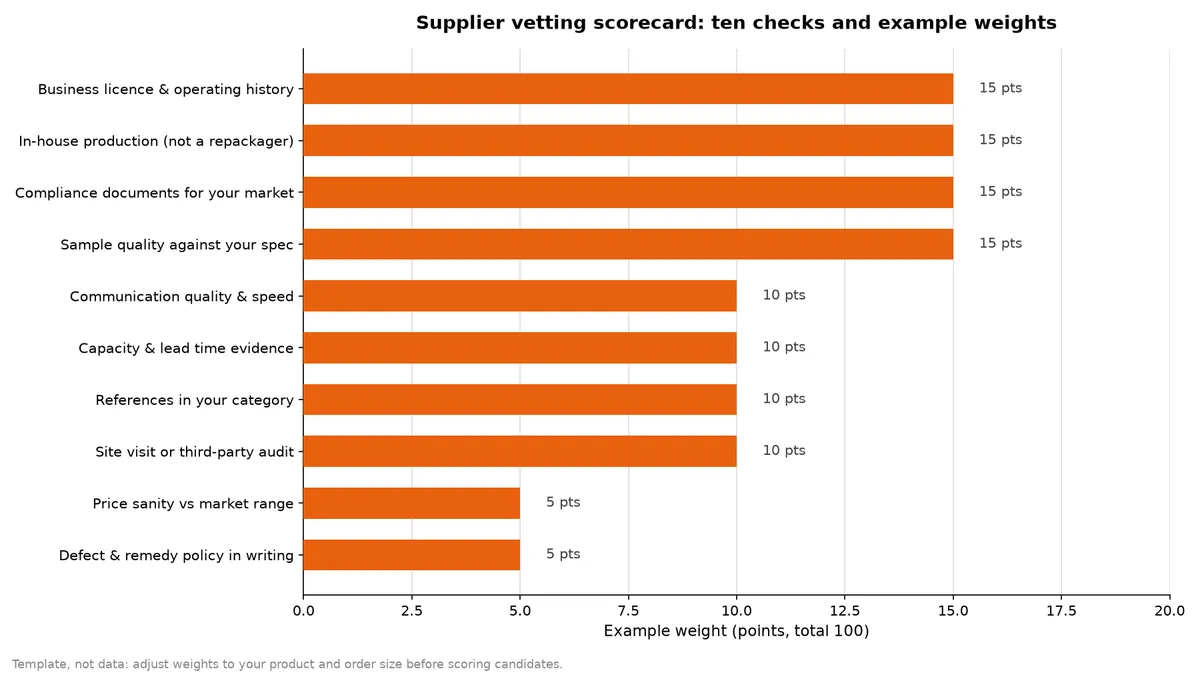
A few of these checks deserve unpacking, because they carry the most weight:
In-house production. Ask directly: "Which processes happen in your factory, and which do you buy in?" Then test the answer — ask for a workshop video of your product being made, or the machine list for the relevant process. A trading company is not automatically disqualified; you just need to know that is what you are dealing with, because it changes who can fix a defect and how many margins sit between you and the machine.
Compliance documents for your market. The documents that matter depend entirely on the product and destination: test reports against the relevant standards, certifications where the category requires them, and material declarations. Two rules keep this honest: certificates must match the exact model, not "a similar product", and you should know which standards apply to your own SKU before you ask — a supplier who educates you accurately here is showing real competence. Our guides on verifying a supplier and verifying a factory go document-by-document.
References in your category. A factory that has produced for your category — kitchen storage, pet products, automotive accessories, whichever yours is — already knows the failure modes and the compliance landscape. Ask which markets they currently ship to, and for the product types rather than confidential client names.
Capacity and lead time evidence. Not the number on the profile — the evidence: current order book shape, typical lead time for your product class, what happens to your schedule when peak season hits, and who owns your order when it slips.
Step 4: Use the Sample as an Evaluation Event
A sample is not a gift to confirm your decision; it is the most information-dense data point in the whole process. Ship the same spec to your top two or three candidates, test against a written list, and — critically — send defects back with photographs. How a supplier responds to a documented defect list (defensive? silent? corrective?) predicts the production relationship better than any certificate. The full method is in our sample evaluation guide.
One addition most buyers skip: score the packaging and paperwork of the sample shipment itself. A sample that arrives in crushed retail packaging with a handwritten customs invoice is a data point about export experience, and it costs you nothing to collect.
Step 5: The Red Flags That Should End a Conversation
Not every weakness is disqualifying; some are. These have ended negotiations for good reasons:

- Prices dramatically below the market range with no explanation of how — the difference is being taken out of material, QC, or your order's priority.
- Refusing any form of verifiable identity: no business licence number, no verifiable address, pushback on a simple video call.
- Certificates that cannot be matched to the exact model, or "we have all certificates, don't worry" as a complete answer.
- Pressure tactics: "this price expires today", deposits to a personal account, or a sudden new "manager" who takes over the conversation.
- A defect report answered with silence or blame instead of a corrective plan.
- The company name on the quotation, the bank account, and the business licence are three different companies.
Any one of these is survivable with explanation; two or more together are a pattern, and patterns do not improve after the deposit.
When to Run This Process Through a Sourcing Service
Vetting well costs time: dozens of messages, document checks in a language you may not read, and judgment calls about answers that are technically true and practically misleading. Many sellers at the stage where orders grow past a few thousand dollars hand the search-and-evaluation layer to a service and keep the decisions.
That is the layer AllexTrade runs: we search and screen candidate suppliers for your product, approach them with your specification, collect comparable quotes, coordinate samples and pre-shipment quality checks, and bring you a shortlist with the evidence attached. Suppliers in our network are screened before they reach your quotation sheet, we reply to requests within 24 hours, and quotes typically arrive within 3–5 business days.
Send your product reference, target market, and estimated quantity through our sourcing request form, or read how the service works. If you want to run the vetting process yourself first, the three guides linked at the top of this article cover each stage in depth.
Frequently Asked Questions
What does "vetting" a Chinese supplier actually involve? It is a structured evaluation before money moves: building a multi-channel candidate list, scoring first-contact responses for specificity, checking business licence and operating history, confirming which production happens in-house, requesting compliance documents that match your exact product and market, and testing samples against a written checklist. The goal is evidence, not impressions.
How is vetting different from verifying a supplier? Verification usually refers to confirming specific facts — licence, address, certificates, factory existence. Vetting is the wider evaluation that wraps those checks: comparing several candidates on a weighted scorecard and choosing. You verify documents; you vet suppliers.
How many suppliers should I evaluate before choosing? Eight to ten candidates from at least three channels is a workable target: enough to make quote comparison meaningful and to spot price outliers, few enough that each gets a genuine conversation. Evaluating only one or two leaves you negotiating without a reference point.
Is it safe to buy from a trading company instead of a factory? It can be, if you know that is what you are dealing with. Trading companies add a margin and a communication layer, but good ones add supplier management you cannot do from abroad. The risk is not the label — it is a repackager presenting itself as a factory, which is why in-house production is a scored check, not a taken claim.
What is the single biggest red flag when vetting a supplier? Inconsistency across identities: the quotation company, the bank account, and the business licence do not match. Combined with unverifiable certificates or prices far below market with no explanation, it should end the conversation regardless of how good the product photos look.
Small batch? That's our specialty.
AllexTrade negotiates low-MOQ production across screened factories. Tell us your product and target quantity and we'll come back with realistic options and prices — timing depends on how quickly suppliers respond.